GreeniacsArticles
Waste
Recycling Plastics
|
Written by Natalya Stanko
|
||||
| Thursday, 13 October 2011 | ||||
Recycling PlasticsFirst, the plastics are sorted by hand on a conveyor belt. They are compacted and baled. These bales are sold to a reclaiming facility. According to Washington State's Department of Ecology, “[a]t this point, entire bales can be rejected as unclean or 'contaminated' by the wrong colors or types of plastic.”2 Second, the approved plastic is washed and ground into small flakes. The flakes are dried, melted, filtered, and formed into pellets, which are sold to manufacturing plants that make new plastic products. PET (#1 plastics) are turned into textiles for your carpet or fleece jacket. HDPE (#2 plastics) are used to manufacture new plastic bottles.3 For more on what the numbers on your plastic goods mean, read here
4
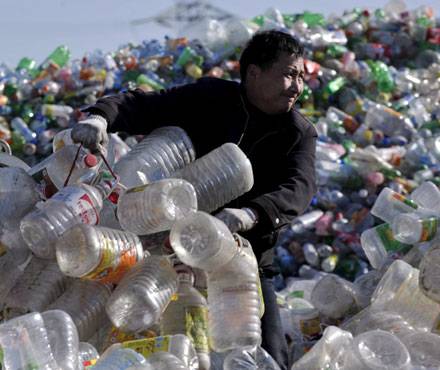
Third, some plastics get sent to local reclaiming facilities. For example, Trex Company in Virginia recycles 1.3 billion U.S. grocery retail bags annually and then manufactures the waste into wood-alternative decking, railing, and fencing products.5 But companies like Trex are not common in the United States. In fact, Trex alone recycles 70% of all plastic bags in the U.S. recycling system.6 Then here comes the dirty side of our recycling system… Remarkably, most recycled plastics in the U.S. are shipped to China. China also collects one-third of the United Kingdom’s plastics,7 and a whopping 82% of all plastics recycled in Winnipeg, Canada!8 The plastic's trip halfway around the world wastes tons of fossil fuels! The only sunny side to this statistic is that because the U.S. imports more than it exports, the plastics are sent in shipping containers that might otherwise be empty… so not quite as much fossil fuel wasted, but regardless it is still a waste. In China, the recycling of plastics is often an environmental and health hazard. According to Van Jones, a human rights activist and President Obama's former advisor on green jobs, “Recycling of plastic in many developing countries means the incineration of the plastic, the burning of the plastic, which releases incredible toxic chemicals and ... kills people.”9 Burning plastic such as PVC releases dioxins, which can cause cancer in people. Because recycling procures little profit (and even less during the global economic downturn), workers often labor for little money and in unfair conditions. Keep in mind that Asia is home to 60% of the world's 350 million child laborers.10
11
And what happens to the majority of traveling plastic that (thankfully) isn’t burned? Most plastics are NOT recycled. Instead, these plastics are “downcycled” into durable goods like fly swatters and dolls. Durable goods are not recyclable. So, most plastic in your big blue bin will get a second life (maybe even a third), but then it will inevitably end up in a landfill.12 The recycling symbol's little green arrows suggest that products are remade into other products over and over again, but that's typically not the case. So what about all of the plastics that we do NOT try to recycle by placing them in the big blue bin? In 2009, only 7% of the plastic generated in the U.S. was recovered for recycling.13 That number is low, in part because plastic is more confusing than paper or glass. Most Americans simply don't know much about plastic. Plastic production contributes to 10% of U.S. oil consumption.14 However, about 72% of Americans don't even know that plastic is made of petroleum!15 Moreover, 40% of Americans think that plastic biodegrades and it most certainly doesn't.16 Though most plastics are branded with a number surrounded by a recycling symbol, that symbol does not necessarily mean that plastic container is recyclable. Lots of foods, like yogurt and cottage cheese, are packaged in #5 plastic containers, but recycling facilities rarely accept #5 plastics.17 There are about seven different types of plastic in circulation today, and they cannot all be mixed. Plastic bottle caps don't go with plastic bottles,18 and grocery bags can't be reused in the same way as clothing-store bags. That's because clothing-store bags are generally thicker and are made from the resin LDPE 4. Supermarket bags are typically thinner and made of HDPE 2. When a stray LDPE 4 wanders into a batch of HDPE 2 during recycling, it can contaminate and weaken the resulting plastic.19 What is a consumer to do? Before recycling plastics, learn the proper procedures for your community's recycling program 1 http://www.greatgarbagepatch.org/ 2 http://www.portaec.net/library/recycling/what_happens_to_recycled_plastic.html 3 http://www.epa.gov/osw/conserve/materials/plastics.htm 4 http://www.wendmag.com/greenery/2009/11/where-does-your-recycling-end-up/ 5 http://www.trex.com/company/our-story/index.htm 6 http://edition.cnn.com/2008/WORLD/asiapcf/04/06/eco.plastics/index.html 7 http://www.guardian.co.uk/society/2004/sep/20/environment.china 8 http://www.cbc.ca/news/canada/manitoba/story/2010/11/09/ man-recycling-garbage-plastics-expo.html 9 http://www.ted.com/talks/van_jones_the_economic_injustice_of_plastic.html 10 http://www.usatoday.com/news/world/2007-09-03-china-labor_N.htm 11 http://www.metro.co.uk/news/pictures/photos-02115/pictures-of-the-day-march-9/3 12 http://www.cbc.ca/news/canada/manitoba/story/2010/11/09/ man-recycling-garbage-plastics-expo.html 13 http://www.epa.gov/osw/conserve/materials/plastics.htm 14 http://ir.metabolix.com/releasedetail.cfm?ReleaseID=239056 15 http://www.aquaspring.com/effects-of-bottled-water.php 16Id. 17 http://eartheasy.com/live_recycling.htm 18 http://www.portaec.net/library/recycling/what_happens_to_recycled_plastic.html 19 http://edition.cnn.com/2008/WORLD/asiapcf/04/06/eco.plastics/index.html
Only registered users can write comments. |
||||
| Last Updated ( Thursday, 27 October 2011 ) | ||||
SEARCH GREENIACS.COM
Latest News
- Gas Pipeline Beneath Hudson River Is Approved
- Fast-moving Nevada wildfire destroys seven homes
- Green Blog: On Our Radar: An Energy Challenge for Gamers
- Green Blog: A Genetic Cure for Tomato Rot
- Ivorian minister resigns over toxic dumping scandal
- Ohio lawmakers set new limits on owning exotic animals
Green Facts
-
Recycling 100 million cell phones can save enough energy to power 18,500 homes in the U.S. for a year.
-
Americans throw away more than 120 million cell phones each year, which contribute 60,000 tons of waste to landfills annually.
-
Recycling for one year at Stanford University saved the equivalent of 33,913 trees and the need for 636 tons of iron ore, coal, and limestone.
-
Turning off the tap when brushing your teeth can save as much as 10 gallons a day per person.
-
82 percent of greenhouse gas emissions in the U.S. come from burning fossil fuels.
-
The World Health Organization estimates that 2 million people die prematurely worldwide every year due to air pollution.
-
A laptop consumes five times less electricity than a desktop computer.
-
A single quart of motor oil, if disposed of improperly, can contaminate up to 2,000,000 gallons of fresh water.
-
Recycling 1 million laptop computers can save the amount of energy used by 3,657 homes in the U.S. over the course of a year.
-
An aluminum can that is thrown away instead of recycled will still be a can 500 years from now!
-
Rainforests are being cut down at the rate of 100 acres per minute.
-
You will save 100 pounds of carbon for each incandescent bulb that you replace with a compact fluorescent bulb (CFL), over the life of the bulb.
-
Glass can be recycled over and over again without ever wearing down.
-
American workers spend an average of 47 hours per year commuting through rush hour traffic. This adds up to 23 billion gallons of gas wasted in traffic each year.
-
Shaving 10 miles off of your weekly driving pattern can eliminate about 500 pounds of carbon dioxide emissions a year.
-
A steel mill using recycled scrap reduces related water pollution, air pollution, and mining wastes by about 70%.
-
In California homes, about 10% of energy usage is related to TVs, DVRs, cable and satellite boxes, and DVD players.
-
Americans throw away enough aluminum to rebuild our entire commercial fleet of airplanes every 3 months
-
Bamboo absorbs 35% more carbon dioxide than equivalent stands of trees.
-
States with bottle deposit laws have 35-40% less litter by volume.
-
You’ll save two pounds of carbon for every 20 glass bottles that you recycle.
-
One recycled aluminum can will save enough energy to run a 100-watt bulb for 20 hours, a computer for 3 hours, or a TV for 2 hours.
-
A tree that provides a home with shade from the sun can reduce the energy required to run the air conditioner and save an additional 200 to 2,000 pounds of carbon over its lifetime.
-
Americans use 100 million tin and steel cans every day.
-
Less than 1% of electricity in the United States is generated from solar power.
-
Every week about 20 species of plants and animals become extinct.
-
If every U.S. household turned the thermostat down by 10 degrees for seven hours each night during the cold months, and seven hours each weekday, it would prevent nearly gas emissions.
-
Current sea ice levels are at least 47% lower than they were in 1979.
-
Refrigerators built in 1975 used 4 times more energy than current models.
-
In the United States, automobiles produce over 20 percent of total carbon emissions. Walk or bike and you'll save one pound of carbon for every mile you travel.
-
For every 38,000 bills consumers pay online instead of by mail, 5,058 pounds of greenhouse gases are avoided and two tons of trees are preserved.
-
Nudge your thermostat up two degrees in the summer and down two degrees in the winter to prevent 2,000 pounds of carbon dioxide from entering the atmosphere.
-
Plastic bags and other plastic garbage thrown into the ocean kill as many as 1,000,000 sea creatures every year.
-
You will save 300 pounds of carbon dioxide for every 10,000 miles you drive if you always keep your car’s tires fully inflated.
-
Recycling aluminum saves 95% of the energy used to make the material from scratch.
-
Washing your clothes in cold or warm instead of hot water saves 500 pounds of carbon dioxide a year, and drying your clothes on a clothesline six months out of the year would save another 700 pounds.
-
77% of people who commute to work by car drive alone.
-
Due to tiger poaching, habitat destruction, and other human-tiger conflicts, tigers now number around 3,200—a decrease in population by about 70% from 100 years ago.
-
It takes 6,000,000 trees to make 1 year's worth of tissues for the world.


4
11